Saturday, August 30, 2008
Local Government Commission for England
The Local Government Commission for England was the body responsible for reviewing the structure of local government in England from 1992 to 2002. It was established under the Local Government Act 1992 replacing the Local Government Boundary Commission for England. The Commission could be ordered by the Secretary of State to undertake 'structural reviews' in specified areas and recommend the creation of unitary authorities in the two-tier shire counties of England. The Commission, chaired by John Banham, conducted a review of all the non-metropolitan counties of England from 1993 to 1994, making various recommendations on their future. After much political debate and several legal challenges, the Commission's proposals resulted in the abolition of Berkshire county council and the counties of Avon, Cleveland, Hereford and Worcester and Humberside. Combined with a second wave of reviews in 1995, under the chairmanship of David Cooksey, the Commission's proposals led to the creation of unitary authorities covering many urban areas of England. It was replaced by the Boundary Committee for England in 2002, which finished this review cycle in 2004


Thursday, August 21, 2008
To Enable Regedit When infected by virus
How to enable registry whe infected by virus
When your registry is being disabled:
First, maybe the administrator disabled it for some restriction purposes
Second, due to virus. Most of the virus disabled the regedit for you to unable to stop the execution of its program.
Here are the solutions for enabling the regedit again.
- Use the gpedit.msc to enable the registry editor.
Step 1: Hit the window or click start button then press "r" or simply click the run
Step 2: type gpedit.msc
Step 3: Click on Administrative Templates
Step 4: Click the System and locate the Prevent access to registry editing tools and double click on it
Step 5: Select the enabled on the optionbutton the click apply.
This will make a policy to prevent access to the registry editing tools, The computer will automatically made the policy.
Step 6: After clicking on apply select the disabled in the option button then click the apply again then click ok button when finished.
The disabled button will make the policy into default, the computer will automatically configured it and becomes a default comfig which is the registry editor can be access by the user.
And Thats it... Try run the regedit.exe... Have Fun!!!!
To Enable/Disable Task Manager
Here's How:
- Click Start
- Click Run
- Type REGEDIT
- Click OK The Registry Editor will now open
- Browse to the following key:
HKEY_CURRENT_USER\Software\Microsoft\Windows\
CurrentVersion\Policies\system - In the right pane, look for the value: DisableTaskMgr
- Right click DisableTaskMgr and select Delete. (When prompted with "Are you sure you want to delete this value", select Yes.
- Now browse to the following key:
HKEY_LOCAL_MACHINE\SOFTWARE\Microsoft\Windows\
CurrentVersion\policies\system - In the right pane, look for the value: DisableTaskMgr
- Right click DisableTaskMgr and select Delete. (When prompted with "Are you sure you want to delete this value", select Yes.
- Close the Registry by choosing File | Exit
- You should now be able to access Task Manager. If not, reboot into Safe Mode and repeat the steps outlined above.
Tuesday, August 19, 2008
To Uninstall Oracle 10g
Uninstalling Oracle 10g Manually from Windows XP
Oracle's installation utility has a nasty habit of leaving a lot of items behind.
I wrote this up to document what I've found you need to do to uninstall Oracle 10g manually.
This is specific to 10g and Windows XP. Removing 9i is very similar if I remember right,
but who's using 9i anymore? ;-)
The first thing you should do, is go ahead and run the installation tool to do an uninstall.
It probably will leave some things behind, but it's worth running.
Then go through this list and remove anything it missed.
This list is detailed enough though, that I believe even if you did not run the
uninstallation tool, this would fully uninstall Oracle.
The most commonly missed item is to make sure you remove everything from the GAC because
the uninstaller doesn't appear to. I get to that later, but if you wanted to know the
largest source of uninstallation problems, it's libraries remaining in the GAC.
After running the supplied Oracle uninstallation utility
(which may or may not do some or all of the following):
# Stop any Oracle services that have been left running.
Start->Settings->Control Panel->Services
Look for any services with names starting with 'Oracle' and stop them.
# Run regedit and delete the following keys (some may have slightly different names
in your registry):
HKEY_CURRENT_USER\SOFTWARE\ORACLE
HKEY_LOCAL_MACHINE\SOFTWARE\ORACLE
HKEY_LOCAL_MACHINE\SYSTEM\CurrentControlSet\Services\EventLog\Application\Oracle.oracle
HKEY_LOCAL_MACHINE\SYSTEM\CurrentControlSet\Services\OracleDBConsole
HKEY_LOCAL_MACHINE\SYSTEM\CurrentControlSet\Services\Oracle10g_home
HKEY_LOCAL_MACHINE\SYSTEM\CurrentControlSet\Services\OraclService
Note that the services control panel will still show the old services until you reboot.
# Delete the Oracle home directory
C:\Oracle
# Delete the Oracle Program Files directory:
C:\Program Files\Oracle
# Delete the Oracle Start Menu shortcuts directory:
C:\Documents and Settings\All Users\Start Menu\Programs\Oracle*
Where * indicates the name of your install. Look for and remove all Oracle directories
from that location.
# Remove Oracle refereces from the path. To edit your path go to:
Start->Settings->Control Panel->System->Advanced->Environment Variables
Edit both of the environment variables user PATH and system PATH.
Remove any Oracle references in them.
# Remove Oracle.DataAccess and any Polic.Oracle files from the GAC which is at:
C:\Windows\assembly\
There, now your system is Oracle free. If you are installing a new instance of Oracle
(and not just an additional DB) I recommend you do this before any new Oracle installation.
Note: I used several other websites and searches as references when developing these steps,
but I was unable to find any steps that covered all of the items for Oracle 10g so I
assembled them here.
Oracle's installation utility has a nasty habit of leaving a lot of items behind.
I wrote this up to document what I've found you need to do to uninstall Oracle 10g manually.
This is specific to 10g and Windows XP. Removing 9i is very similar if I remember right,
but who's using 9i anymore? ;-)
The first thing you should do, is go ahead and run the installation tool to do an uninstall.
It probably will leave some things behind, but it's worth running.
Then go through this list and remove anything it missed.
This list is detailed enough though, that I believe even if you did not run the
uninstallation tool, this would fully uninstall Oracle.
The most commonly missed item is to make sure you remove everything from the GAC because
the uninstaller doesn't appear to. I get to that later, but if you wanted to know the
largest source of uninstallation problems, it's libraries remaining in the GAC.
After running the supplied Oracle uninstallation utility
(which may or may not do some or all of the following):
# Stop any Oracle services that have been left running.
Start->Settings->Control Panel->Services
Look for any services with names starting with 'Oracle' and stop them.
# Run regedit and delete the following keys (some may have slightly different names
in your registry):
HKEY_CURRENT_USER\SOFTWARE\ORACLE
HKEY_LOCAL_MACHINE\SOFTWARE\ORACLE
HKEY_LOCAL_MACHINE\SYSTEM\CurrentControlSet\Services\EventLog\Application\Oracle.oracle
HKEY_LOCAL_MACHINE\SYSTEM\CurrentControlSet\Services\OracleDBConsole
HKEY_LOCAL_MACHINE\SYSTEM\CurrentControlSet\Services\Oracle10g_home
HKEY_LOCAL_MACHINE\SYSTEM\CurrentControlSet\Services\OraclService
Note that the services control panel will still show the old services until you reboot.
# Delete the Oracle home directory
C:\Oracle
# Delete the Oracle Program Files directory:
C:\Program Files\Oracle
# Delete the Oracle Start Menu shortcuts directory:
C:\Documents and Settings\All Users\Start Menu\Programs\Oracle*
Where * indicates the name of your install. Look for and remove all Oracle directories
from that location.
# Remove Oracle refereces from the path. To edit your path go to:
Start->Settings->Control Panel->System->Advanced->Environment Variables
Edit both of the environment variables user PATH and system PATH.
Remove any Oracle references in them.
# Remove Oracle.DataAccess and any Polic.Oracle files from the GAC which is at:
C:\Windows\assembly\
There, now your system is Oracle free. If you are installing a new instance of Oracle
(and not just an additional DB) I recommend you do this before any new Oracle installation.
Note: I used several other websites and searches as references when developing these steps,
but I was unable to find any steps that covered all of the items for Oracle 10g so I
assembled them here.
Saturday, August 16, 2008
Peterloo Massacre
The Peterloo Massacre occurred at St Peter's Field, Manchester, England, on 16 August 1819, when cavalry charged into a crowd of 60–80,000 gathered at a meeting to demand the reform of parliamentary representation. The Manchester Patriotic Union, a group agitating for parliamentary reform, organised a demonstration to be addressed by the well-known radical orator Henry Hunt. Shortly after the meeting began, local magistrates called on the military to arrest Hunt and several others on the hustings with him, and to disperse the crowd. Cavalry charged into the crowd with sabres drawn, and in the ensuing confusion, 15 people were killed and 400–700 were injured, among them many women and children. The massacre was given the name Peterloo in ironic comparison to the Battle of Waterloo, which had taken place four years earlier. Historian Robert Poole has called the Peterloo Massacre one of the defining moments of its age. In its own time, the London and national papers shared the horror felt in the Manchester region, but Peterloo's immediate effect was to cause the government to crack down on reform, with the passing of what became known as the Six Acts. It also led directly to the foundation of the The Manchester Guardian (now The Guardian), but had little other effect on the pace of reform. (more...)
Monday, July 7, 2008
The girl who stud In the rain.... Shud i beliv it?
30-6-2008
ooty,tamilnadu
I dont belive in ghosts.....but i heard a news which lead me to beliv the existence of ghosts . its not just a story...
but it was a great news.....channels and newspapers elaborated it well and made it famous...
its like this...
A cold , rainy night before One and a half years ago , Place:Some lonely road at Nilgiris , time: 9:00 pm
A girl who was about 25 years old was standing near the roadside holding her two or three months old baby.
waiting for any ride in which they can get away from the rain...
A man (i forgot his name),he was a taxi driver , and he was goin home after finishing his work.
He saw the hitch hiker , with a baby inside her arms......he stopped the car and let her inside , she sat on the backseat.
He asked her where she wants to get down....she said him to go as she says....he drew the car through the roads she instructed...
He went on driving and she went on instructing....
About 45 minutes he drew the car...he hided his anger inside and turned back to ask her where does she want to go actually..
He was about to faint seeing that , he was extremely shocked...
The girl was biting on the neck of the baby,the baby was already dead , the Girl's face was fully covered with blood.....
She was looking like a ghost in the dark with her face covered in blood.....
He fainted and dashed the car somwer....
He awake n find tat he was in a hospital.......
---------------------------------------------------------------------------------------------------
I saw his interviews , and other's opinion about this in som local tv channels
Somany other peapl hav seen her b4 , askin for lift...
but he had the fate to hav such an experience.....
I cannot Promise u that Ghost is true or i cant tel tat its false
I donno wat to believe.....
Tel me wat do u think abot this......
Shud i beliv it or not?
ooty,tamilnadu
I dont belive in ghosts.....but i heard a news which lead me to beliv the existence of ghosts . its not just a story...
but it was a great news.....channels and newspapers elaborated it well and made it famous...
its like this...
A cold , rainy night before One and a half years ago , Place:Some lonely road at Nilgiris , time: 9:00 pm
A girl who was about 25 years old was standing near the roadside holding her two or three months old baby.
waiting for any ride in which they can get away from the rain...
A man (i forgot his name),he was a taxi driver , and he was goin home after finishing his work.
He saw the hitch hiker , with a baby inside her arms......he stopped the car and let her inside , she sat on the backseat.
He asked her where she wants to get down....she said him to go as she says....he drew the car through the roads she instructed...
He went on driving and she went on instructing....
About 45 minutes he drew the car...he hided his anger inside and turned back to ask her where does she want to go actually..
He was about to faint seeing that , he was extremely shocked...
The girl was biting on the neck of the baby,the baby was already dead , the Girl's face was fully covered with blood.....
She was looking like a ghost in the dark with her face covered in blood.....
He fainted and dashed the car somwer....
He awake n find tat he was in a hospital.......
----------------------------------------
I saw his interviews , and other's opinion about this in som local tv channels
Somany other peapl hav seen her b4 , askin for lift...
but he had the fate to hav such an experience.....
I cannot Promise u that Ghost is true or i cant tel tat its false
I donno wat to believe.....
Tel me wat do u think abot this......
Shud i beliv it or not?
Monday, May 26, 2008
saleeeem pheku
arey kal krishna obeyrai may dawat thi krishna oberai me party ne blanket hal me chalri, blanket hal me hise gusthe pura loag nachara, myb nachetho pura pottia meraku lapattha,hisa jathe jathe suna wah do loaga tyr ke kya boli malum "arey inu english film ka hero dikra" my seeda jake table pe byta hua ek waiter ake kya bola malum "sir any thing tanda garam" my kya bola malum mytho sharab tho nai peetha ek allmix fruit juice la bola" samme se mallika aya (arey mallika koun(ismail bai)) arey murder yaroo ake uper girar ra "arey mallika thu kya kar ra boletho kya boli malum hisi kama karetho bahuth popular hotha bola badh me mere per lapat ke idhar puppi uder puppi mera kulna bandh ogayi(kya bandh ogayi saleem (jahangeer)) arey mera sas yaroo ek beer pineke badh kya bola malum
mallika-"saleem mujje long drive pe jaana hain"
hamara saleem miya -"rey hyd me long drive kaha leke jana, hisa gadi me bita begam pet se panja gutta mara panjagutta se nacleseroad mara,abh kya boli malum .
mallika-"saleem muje icecream hona" bolte he
sida mohanjahi market kan roka,arey mashur icecream hain na yaaro
vahha panch pach cup ice cream.
ismail bhai"panch pach cup"
saleem-"arey ithe ithe cup atha na " kaliye baad mai bola ab to tum thande hogaye sida uskho lekar jaya kirshana oberio tak aab tum jao ghar kho main bhi jaroo .gud nite.
tho who kya bole maloom "saleem aab tum jana vana nahi ise kaise hota tum mare saath room ko chalo kuch bathana hai"
aab main kya kara who bolre bolke room kho chala gaya.aaab room kho chale janeke baad raath bar kya hua maloom nakho pucho.
jahangir - neend main se aankh kab kuli yaaro teri
saleem- subha.
mallika-"saleem mujje long drive pe jaana hain"
hamara saleem miya -"rey hyd me long drive kaha leke jana, hisa gadi me bita begam pet se panja gutta mara panjagutta se nacleseroad mara,abh kya boli malum .
mallika-"saleem muje icecream hona" bolte he
sida mohanjahi market kan roka,arey mashur icecream hain na yaaro
vahha panch pach cup ice cream.
ismail bhai"panch pach cup"
saleem-"arey ithe ithe cup atha na " kaliye baad mai bola ab to tum thande hogaye sida uskho lekar jaya kirshana oberio tak aab tum jao ghar kho main bhi jaroo .gud nite.
tho who kya bole maloom "saleem aab tum jana vana nahi ise kaise hota tum mare saath room ko chalo kuch bathana hai"
aab main kya kara who bolre bolke room kho chala gaya.aaab room kho chale janeke baad raath bar kya hua maloom nakho pucho.
jahangir - neend main se aankh kab kuli yaaro teri
saleem- subha.
Sunday, May 11, 2008
saleem famous dialogs
mallika-"saleem mujje long drive pe jaana hain"
hamara saleem miya -" ab main usse hyd main long drive pe khaha le jaoo asse banjara hill se panjagutta se sida niclace road se tak band par lete he kya bole maloom .
mallika-"saleem mereku icecream hona" bolte he
to main mohanjahi market kan roka arre mashur icecream hain na yaaron vahha panch pach cup ice cream.
ismail bhai"panch pach cup"
saleem-"arre ithe ithe cup the yaaro" kaliye baad mai bola ab to tum thande hogaye sida uskho lekar jaya kirshana oberio tak aab tum jao ghar kho main bhi jaroo .gud nite.
tho who kya bole maloom "saleem aab tum jana vana nahi ise kaise hota tum mare saath room ko chalo kuch bathana hai"
aab main kya kara who bolre bolke room kho chala gaya.aaab room kho chale janeke baad raath bar kya hua maloom nakho pucho.
jahangir - neend main se aankh kab kuli yaaro teri
saleem- subha.
hamara saleem miya -" ab main usse hyd main long drive pe khaha le jaoo asse banjara hill se panjagutta se sida niclace road se tak band par lete he kya bole maloom .
mallika-"saleem mereku icecream hona" bolte he
to main mohanjahi market kan roka arre mashur icecream hain na yaaron vahha panch pach cup ice cream.
ismail bhai"panch pach cup"
saleem-"arre ithe ithe cup the yaaro" kaliye baad mai bola ab to tum thande hogaye sida uskho lekar jaya kirshana oberio tak aab tum jao ghar kho main bhi jaroo .gud nite.
tho who kya bole maloom "saleem aab tum jana vana nahi ise kaise hota tum mare saath room ko chalo kuch bathana hai"
aab main kya kara who bolre bolke room kho chala gaya.aaab room kho chale janeke baad raath bar kya hua maloom nakho pucho.
jahangir - neend main se aankh kab kuli yaaro teri
saleem- subha.
Friday, April 25, 2008
india's cricket schedule
June 2008 | | ||||
| Date | Time (GMT) | Match Details | Venue | ||
| Wed 25 | Hong Kong v India, Group B, 2nd Match, Asia Cup, 2008 | Karachi (D/N) | |||
| Thu 26 | India v Pakistan, Group B, 3rd Match, Asia Cup, 2008 | Karachi (D/N) | |||
July 2008 | | ||||
| Date | Time (GMT) | Match Details | Venue | ||
| Fri 18 - Sun 20 | Sri Lanka v India, Three-day warm-up match | Colombo | |||
| Wed 23 - Sun 27 | Sri Lanka v India, 1st Test | Colombo (SSC) | |||
| Thu 31 - Mon 04 | Sri Lanka v India, 2nd Test | Galle | |||
August 2008 | | ||||
| Date | Time (GMT) | Match Details | Venue | ||
| Fri 08 - Tue 12 | Sri Lanka v India, 3rd Test | Colombo (RPS) | |||
| Fri 15 | Sri Lanka v India, One-day warm-up match | Colombo (RPS) | |||
| Mon 18 | Sri Lanka v India, 1st ODI | Dambulla | |||
| Wed 20 | Sri Lanka v India, 2nd ODI | Dambulla | |||
| Sun 24 | Sri Lanka v India, 3rd ODI | Colombo - RPS (D/N) | |||
| Tue 26 | Sri Lanka v India, 4th ODI | Colombo - RPS (D/N) | |||
| Fri 29 | Sri Lanka v India, 5th ODI | Colombo - RPS (D/N) | |||
September 2008 | | ||||
| Date | Time (GMT) | Match Details | Venue | ||
| Sat 13 | Australia v India, Group A-2nd Match, ICC Champions Trophy, 2008 | Lahore | |||
| Tue 16 | India v West Indies, Group A-3rd Match, ICC Champions Trophy, 2008 | Karachi | |||
| Sat 20 | Pakistan v India, Group A-5th Match, ICC Champions Trophy, 2008 | Lahore | |||
October 2008 | | ||||
| Date | Time (GMT) | Match Details | Venue | ||
| Thu 09 - Mon 13 | India v Australia, 1st Test | Bangalore | |||
| Fri 17 - Tue 21 | India v Australia, 2nd Test | Mohali | |||
| Tue 28 - Sat 01 | India v Australia, 3rd Test | Delhi | |||
November 2008 | | ||||
| Date | Time (GMT) | Match Details | Venue | ||
| Wed 05 - Sun 09 | India v Australia, 4th Test | Nagpur | |||
Wednesday, April 23, 2008
Abdul saab
"Look at the sky. We are not alone. The whole universe is friendly to us and conspires only to give the best to those who dream and work"
- A.P.J. Abdul Kalam
(Dr. Avul Pakir Jainulabdeen Abdul Kalam)
Dr A.P.J. Abdul Kalam is the undisputed father of India's missile program. He has breathed life into ballistic missiles like the Agni and Prithvi,it is too exhausting to track Dr Abdul Kalam's achievements to date. By the '90s Kalam emerged as the czar of Indian science and technology and was awarded the BHARAT RATNA.
Kalam's advice to the youngsters of the nation is to "DREAM,DREAM,AND DREAM AND CONVERT THESE INTO THOUGHTS AND LATER INTO ACTIONS."
"Unless India stands up to the world, no one will respect us. In this world, fear has no place. Only strength respects strength"
Website: www.abdulkalam.com
Write to Dr.Kalam :apj@abdulkalam.com
- A.P.J. Abdul Kalam
(Dr. Avul Pakir Jainulabdeen Abdul Kalam)
Dr A.P.J. Abdul Kalam is the undisputed father of India's missile program. He has breathed life into ballistic missiles like the Agni and Prithvi,it is too exhausting to track Dr Abdul Kalam's achievements to date. By the '90s Kalam emerged as the czar of Indian science and technology and was awarded the BHARAT RATNA.
Kalam's advice to the youngsters of the nation is to "DREAM,DREAM,AND DREAM AND CONVERT THESE INTO THOUGHTS AND LATER INTO ACTIONS."
"Unless India stands up to the world, no one will respect us. In this world, fear has no place. Only strength respects strength"
Website: www.abdulkalam.com
Write to Dr.Kalam :apj@abdulkalam.com
Saturday, April 12, 2008
Kansas Turnpike
The Kansas Turnpike is a tolled freeway that lies entirely within the U.S. state of Kansas. The road runs in a general southwest-northeast direction from the Oklahoma border south of Wichita via Wichita, Topeka, and Lawrence to Kansas City, Kansas. The Kansas Turnpike Act defined the turnpike to be built from Oklahoma to Kansas City, Kansas. The turnpike is owned and maintained by the Kansas Turnpike Authority (KTA), headquartered in Wichita. The Kansas Turnpike was built from 1954 to 1956, predating the Interstate Highway System. The turnpike presently has 27 interchanges and two barrier toll plazas. Exit numbers are assigned by mileage from south to east. After passing the Bonner Springs interchange, exit numbers change to match the mileage of Interstate 70 east from the Colorado border. In the median at mile 97 is the Matfield Green Service Area, which contains a memorial to football coach Knute Rockne, who died in a plane crash near Bazaar, Kansas.
Wednesday, April 9, 2008
Victoria Cross
he Victoria Cross is the highest military decoration awarded for valour "in the face of the enemy" to members of the armed forces of some Commonwealth countries and previous British Empire territories. It takes precedence over all other orders, decorations, medals and postnominals. It may be awarded to a person of any rank in any service and civilians under military command, and is presented to the recipient by the British monarch during an investiture held at Buckingham Palace. It is the joint highest award for bravery in the United Kingdom with the George Cross, which is the equivalent honour for valour not "in the face of the enemy". The VC was introduced on 29 January 1856 by Queen Victoria to reward acts of valour during the Crimean War. Since then the medal has been awarded 1,356 times to 1,353 individual recipients. Only 14 medals have been awarded since the end of the Second World War. Due to its rarity, the VC is highly prized and the medal can reach over £200,000 at auction. There are a number of public and private collections devoted to it, most notably that of Lord Ashcroft, which contains over one-tenth of the total VCs awarded.
Sunday, April 6, 2008
Tomb of Antipope John XXIII
The Tomb of Antipope John XXIII is the marble tomb monument for Antipope John XXIII, Baldassare Coscia, created by Donatello and Michelozzo, and located in the Florence Baptistry adjacent to Florence Cathedral. It was commissioned by the executors of Coscia's will after his death on December 22, 1419 and completed during the 1420s, establishing it as one of the early landmarks of Renaissance Florence. According to Ferdinand Gregorovius, the tomb is "at once the sepulchre of the Great Schism in the church and the last Papal tomb which is outside Rome itself". The tomb monument's design included three Virtues, Coscia's family arms, a gilded bronze effigy supported above a inscription-bearing sarcophagus, a Madonna and Child in a half-lunette, and a canopy. At the time of its completion, the monument was the tallest sculpture in Florence, and one of very few tombs within the Baptistry or the neighboring Cathedral. The tomb monument was the first of several collaborations between Donatello and Michelozzo, and the attribution of its various elements to each of them has been debated by art historians, as have the interpretations of its design and iconography
Sunday, March 30, 2008
Nuclear Weapon
A nuclear weapon is a tool employed to injure, defeat, or destroy an adversary. It derives its destructive force from nuclear reactions of fission or fusion. As a result, even a nuclear weapon with a small yield is significantly more powerful than the largest conventional explosives, and a single weapon is capable of destroying an entire city.
In the history of warfare, nuclear weapons have been used only twice, both during the closing days of World War II. The first event occurred on the morning of August 6, 1945, when the United States dropped a uranium gun-type device code-named "Little Boy" on the Japanese city of Hiroshima. The second event occurred three days later when the United States dropped a plutonium implosion-type device code-named "Fat Man" on the city of Nagasaki. The use of these weapons, which resulted in the immediate deaths of around 100,000 to 200,000 people and even more over time, was and remains controversial.
Since the Hiroshima and Nagasaki bombings, nuclear weapons have been detonated on over two thousand occasions for testing and demonstration purposes. The only countries known to have detonated such weapons are (chronologically) the United States,Soviet Union, United Kingdom, France, People's Republic of China, India, Pakistan, and North KoreaFriday, March 21, 2008
Paleolithic and Neolithic periods
Paleolithic and Neolithic periods
Archaeological evidence indicates that a developed Egyptian society and culture extended far beyond the borders of unified Egypt into prehistory (see Predynastic Egypt). The Nile River, around which much of the population of the country clusters, has been the lifeline for Egyptian culture since nomadic hunter-gatherers began living along the Nile during the Pleistocene. Traces of these early people appear in the form of artifacts and rock carvings along the terraces of the Nile and in the oases.
Along the Nile, in the 11th millennium BC, a grain-grinding culture using the earliest type of sickle blades had been replaced by another culture of hunters, fishers, and gathering people using stone tools. Evidence also indicates human habitation and cattle herding in the southwestern corner of Egypt, near the Sudan border, before 8000 BC. Geological evidence and computer climate modeling studies suggest that natural climate changes around 8000 BC began to desiccate the extensive pastoral lands of northern Africa, eventually forming the Sahara (c.2500 BC). Early tribes in the region naturally tended to aggregate close to the Nile River where they developed a settled agricultural economy and more centralized society. There is evidence of pastoralism and cultivation of cereals in the East Sahara in the 7th millennium BC.
Continued desiccation forced the early ancestors of the Egyptians to settle around the Nile more permanently and forced them to adapt a more sedentary lifestyle. However, the period from 9,000 to 6,000 BC has left very little in the way of archaeological evidence. By about 6000 BC, organized agriculture and large building construction had appeared in the Nile Valley.[1] At this time, Egyptians in the southwestern corner of Egypt were herding cattle and also constructing large buildings. Mortar was in use by 4000 BC. The Predynastic Period continues through this time, variously held to begin with the Naqada culture..
Thursday, March 20, 2008
Invisible Women
Susan Storm Richards is a fictional superhero in the Marvel Comics universe. Under the code names of Invisible Girl and later, Invisible Woman, Sue Storm serves as a member of the Fantastic Four. Created by writer Stan Lee and artist/co-writer Jack Kirby, she made her first appearance in Fantastic Four #1 in November 1961.
Like the other founding members of the Fantastic Four, Sue received her powers after being exposed to a cosmic storm. Her primary power deals with light waves, allowing her to render herself and others invisible. However, she can also project powerful fields of invisible energy which she uses for a variety of offensive and defensive effects.
An object of infatuation to adversaries Doctor Doom, and, most notably, Namor the Submariner, Sue's passive invisibility power translated into her frequent deployment as a damsel in distress during the team's early adventures. However, upon developing the ability to project powerful fields of energy, Sue Storm became a more powerful member of the Fantastic Four, and the team's second-in-command. Although in the early years Sue operated somewhat in the shadow of her hot-headed brother, Johnny Storm, and her brilliant husband Reed Richards, she is now the soul of the Fantastic Four and one of the premiere heroes in the Marvel universe.
Sue plays a central role in the lives of her brother, her husband, her children; Franklin Richards and Val Richards and her friend, Ben Grimm.
Sue Storm is portrayed by Jessica Alba in the 2005 film Fantastic Four and its 2007 sequel, Fantastic Four: Rise of the Silver Surfer.
Wednesday, March 19, 2008
Muhammad Ali Jinnah
Muhammad Ali Jinnah was an Indian/Muslim politician and statesman who led the Muslim League and founded Pakistan, serving as the first Governor-General of Pakistan. While celebrated as a great leader in Pakistan, Jinnah remains a controversial figure, provoking intense criticism for his role in the partition of India. As a student and young lawyer, Jinnah rose to prominence in the Indian National Congress, expounded Hindu-Muslim unity, shaped the 1916 Lucknow Pact between the Congress and the Muslim League, and was a key leader in the All India Home Rule League. Differences with Mohandas Gandhi led Jinnah to quit the Congress; he then took charge of the Muslim League and proposed a fourteen-point constitutional reform plan to safeguard the political rights of Muslim in a self-governing India. Disillusioned by the failure of his efforts and the League's disunity, Jinnah would live in London for many years. Several Muslim leaders persuaded Jinnah to return to India in 1934 and re-organize the league. Disillusioned by the failure to build coalitions with the Congress, Jinnah embraced the goal of creating a separate state for Muslims as in the Lahore Resolution. The failure of the Congress-League coalition to govern the country prompted both parties and the British to agree to partition.
Sunday, March 16, 2008
Grauman's Chinese Theater
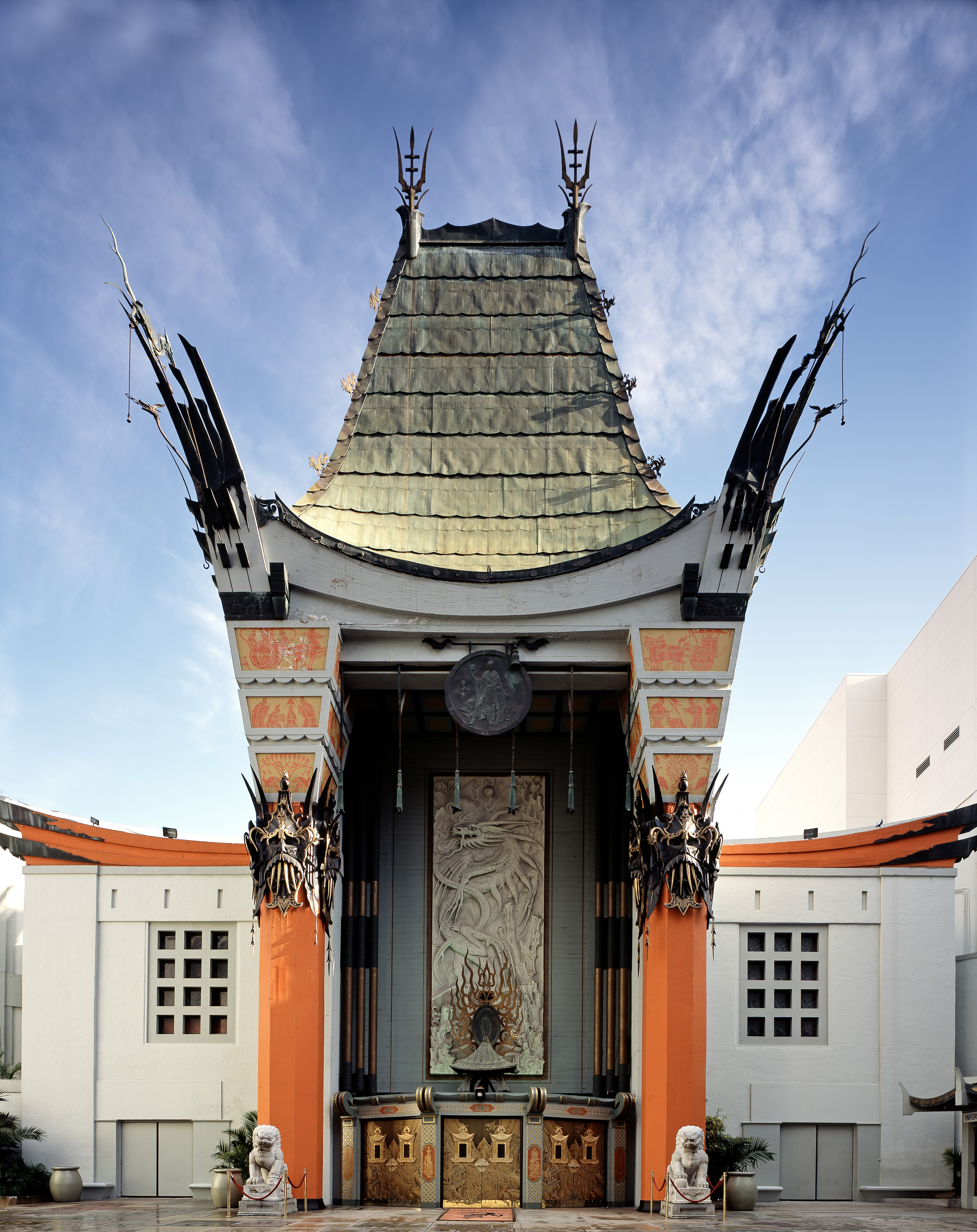
Architecture in Greek ἀρχι-, "archi-", meaning first, prime, or chief and τέκτων, "tekton", meaning builder. It is a multi-disciplinary field, including within its fold mathematics and geometry, science, art, technology, social sciences, politics, history, philosophy, and so on. The first architect known by name was Imhotep from ancient Egypt. The Roman architectural writer, Vitruvius summarized that "Architecture is a science, arising out of many other sciences, and adorned with much and varied learning: by the help of which a judgement is formed of those works which are the result of other arts". He added that an architect should be well versed in fields such as music, astronomy and philosophy. This holds true to this day – as music is a play of pitches/tones with silences (modulation in sound), architecture is a play of solids with voids, geometry with proportion.
The study of philosophy ("lover of wisdom") would be an appropriate attribute for an architect in the days of Vitruvius given the diverse fields of knowledge an architect needs to embody. "Architectural philosophy" is frequently used to describe the approach of an architect; for example, Modernism, Rationalism, empiricism, structuralism, poststructuralism, and phenomenology are some directions from philosophy influencing architecture.
Saturday, March 15, 2008
links for rambo 4
http://rapidshare.com/files/89594070/Rmb4.2008.WP.XviD-THS.Up.By.Chiru.part1.rar
http://rapidshare.com/files/89589847/Rmb4.2008.WP.XviD-THS.Up.By.Chiru.part2.rar
http://rapidshare.com/files/89589829/Rmb4.2008.WP.XviD-THS.Up.By.Chiru.part3.rar
http://rapidshare.com/files/89589867/Rmb4.2008.WP.XviD-THS.Up.By.Chiru.part4.rar
http://rapidshare.com/files/89589851/Rmb4.2008.WP.XviD-THS.Up.By.Chiru.part5.rar
http://rapidshare.com/files/89589874/Rmb4.2008.WP.XviD-THS.Up.By.Chiru.part6.rar
http://rapidshare.com/files/89589900/Rmb4.2008.WP.XviD-THS.Up.By.Chiru.part7.rar
http://rapidshare.com/files/89589774/Rmb4.2008.WP.XviD-THS.Up.By.Chiru.part8.rar
password
www.bugnine.net
http://rapidshare.com/files/89589847/Rmb4.2008.WP.XviD-THS.Up.By.Chiru.part2.rar
http://rapidshare.com/files/89589829/Rmb4.2008.WP.XviD-THS.Up.By.Chiru.part3.rar
http://rapidshare.com/files/89589867/Rmb4.2008.WP.XviD-THS.Up.By.Chiru.part4.rar
http://rapidshare.com/files/89589851/Rmb4.2008.WP.XviD-THS.Up.By.Chiru.part5.rar
http://rapidshare.com/files/89589874/Rmb4.2008.WP.XviD-THS.Up.By.Chiru.part6.rar
http://rapidshare.com/files/89589900/Rmb4.2008.WP.XviD-THS.Up.By.Chiru.part7.rar
http://rapidshare.com/files/89589774/Rmb4.2008.WP.XviD-THS.Up.By.Chiru.part8.rar
password
www.bugnine.net
Wednesday, March 12, 2008
Hitler Autobiography

Hitler's Autobiography, written in Landsberg prison after the putsch and exceeded in popularity by only the Bible.
English translation: My Struggle or My Fight) is the signature work of Adolf Hitler, combining elements of autobiography with an exposition of Hitler's political ideology of Nazism. Volume 1 of Mein Kampf was published in 1925, with volume 2 in 1926.[1]
In Mein Kampf, Hitler makes a biographical account of his life and also describes plans for German-allied countries to rule Europe, along a racist worldview of white supremacy with Aryans as the master race at the top and Jews at the bottom: Germany would re-arm and join Britain and Italy as allies to defeat France and Eastern Europe, eventually overthrowing the Soviet Union to conquer the so-called "twin evils" of Communism and Judaism, giving Germany Lebensraum (living-space) to the east.
In Mein Kampf, Hitler uses the main thesis of "The Jewish peril", which speaks of an alleged Jewish conspiracy to gain world leadership and also warns against the French. Overall, however, it does explain many details of Hitler's childhood and the process by which he became increasingly anti-Semitic and militaristic, especially during his years in Vienna, Austria. In one early chapter, he wrote about how for the first time in the city streets he noticed distinctively dressed Jews unlike those he already knew and then asked himself "Was that a German?" rather than "Was that a Jew?"
This is the link for Hitler Biography
http://rapidshare.com/files/20186558/Adolf_Hitler_-_Mein_Kampf.pdf
Sunday, March 9, 2008
Mother Teresa.....
Mother Teresa was born Agnes Gonxha Bojaxhiu in Skopje*, Macedonia, on August 26**, 1910. Her family was of Albanian descent. At the age of twelve, she felt strongly the call of God. She knew she had to be a missionary to spread the love of Christ. At the age of eighteen she left her parental home in Skopje and joined the Sisters of Loreto, an Irish community of nuns with missions in India. After a few months' training in Dublin she was sent to India, where on May 24, 1931, she took her initial vows as a nun. From 1931 to 1948 Mother Teresa taught at St. Mary's High School in Calcutta, but the suffering and poverty she glimpsed outside the convent walls made such a deep impression on her that in 1948 she received permission from her superiors to leave the convent school and devote herself to working among the poorest of the poor in the slums of Calcutta. Although she had no funds, she depended on Divine Providence, and started an open-air school for slum children. Soon she was joined by voluntary helpers, and financial support was also forthcoming. This made it possible for her to extend the scope of her work.
On October 7, 1950, Mother Teresa received permission from the Holy See to start her own order, "The Missionaries of Charity", whose primary task was to love and care for those persons nobody was prepared to look after. In 1965 the Society became an International Religious Family by a decree of Pope Paul VI.
Today the order comprises Active and Contemplative branches of Sisters and Brothers in many countries. In 1963 both the Contemplative branch of the Sisters and the Active branch of the Brothers was founded. In 1979 the Contemplative branch of the Brothers was added, and in 1984 the Priest branch was established.
The Society of Missionaries has spread all over the world, including the former Soviet Union and Eastern European countries. They provide effective help to the poorest of the poor in a number of countries in Asia, Africa, and Latin America, and they undertake relief work in the wake of natural catastrophes such as floods, epidemics, and famine, and for refugees. The order also has houses in North America, Europe and Australia, where they take care of the shut-ins, alcoholics, homeless, and AIDS sufferers.
The Missionaries of Charity throughout the world are aided and assisted by Co-Workers who became an official International Association on March 29, 1969. By the 1990s there were over one million Co-Workers in more than 40 countries. Along with the Co-Workers, the lay Missionaries of Charity try to follow Mother Teresa's spirit and charism in their families.
Mother Teresa's work has been recognised and acclaimed throughout the world and she has received a number of awards and distinctions, including the Pope John XXIII Peace Prize (1971) and the Nehru Prize for her promotion of international peace and understanding (1972). She also received the Balzan Prize (1979) and the Templeton and Magsaysay awards.
* Former Uskup, a town in the Ottoman Empire.
** Mother Teresa's date of birth is disputed: "So unconcerned was she about accuracy in relation to the chronicling of her own life, and so disinclined actually to read anything written about her, that for many years and in a succession of books her birthdate was erroneously recorded as 27 August 1910. It even appeared in the Indian Loreto Entrance Book as her date of birth. In fact, as she confined to her friend, co-worker and American author, Eileen Egan, that was the date on which she was christened Agnes Gonxha Bojaxhiu. The date which marked the beginning of her Christian life was undoubtedly the more important to Mother Teresa, but she was none the less actually born in Skopje, Serbia, on the previous day." (Spink, Kathryn: Mother Teresa: A Complete Authorized Biography, HarperSanFrancisco, 1997.
Mother Teresa died on September 5, 1997.
POEM ATTRIBUTED TO MOTHER THERESA
People are often unreasonable; illogical, and self centered;
Forgive them anyway.
If you are kind, people may accuse you of selfish, ulterior motives;
Be kind anyway.
If you are successful, you will win some false friends and some true enemies;
Succeed anyway.
If you are honest and frank, people may cheat you;
Be honest and frank anyway.
What you spend years building, someone could destroy overnight;
Build anyway.
If you find serenity and happiness, they may be jealous;
Be happy anyway.
The good you do today, people will often forget tomorrow;
Do good anyway.
Give the world the best you have, and it may never be enough;
Give the world the best you've got anyway.
You see, in the final analysis, it is between you and God;
It was never between you and them.
On October 7, 1950, Mother Teresa received permission from the Holy See to start her own order, "The Missionaries of Charity", whose primary task was to love and care for those persons nobody was prepared to look after. In 1965 the Society became an International Religious Family by a decree of Pope Paul VI.
Today the order comprises Active and Contemplative branches of Sisters and Brothers in many countries. In 1963 both the Contemplative branch of the Sisters and the Active branch of the Brothers was founded. In 1979 the Contemplative branch of the Brothers was added, and in 1984 the Priest branch was established.
The Society of Missionaries has spread all over the world, including the former Soviet Union and Eastern European countries. They provide effective help to the poorest of the poor in a number of countries in Asia, Africa, and Latin America, and they undertake relief work in the wake of natural catastrophes such as floods, epidemics, and famine, and for refugees. The order also has houses in North America, Europe and Australia, where they take care of the shut-ins, alcoholics, homeless, and AIDS sufferers.
The Missionaries of Charity throughout the world are aided and assisted by Co-Workers who became an official International Association on March 29, 1969. By the 1990s there were over one million Co-Workers in more than 40 countries. Along with the Co-Workers, the lay Missionaries of Charity try to follow Mother Teresa's spirit and charism in their families.
Mother Teresa's work has been recognised and acclaimed throughout the world and she has received a number of awards and distinctions, including the Pope John XXIII Peace Prize (1971) and the Nehru Prize for her promotion of international peace and understanding (1972). She also received the Balzan Prize (1979) and the Templeton and Magsaysay awards.
* Former Uskup, a town in the Ottoman Empire.
** Mother Teresa's date of birth is disputed: "So unconcerned was she about accuracy in relation to the chronicling of her own life, and so disinclined actually to read anything written about her, that for many years and in a succession of books her birthdate was erroneously recorded as 27 August 1910. It even appeared in the Indian Loreto Entrance Book as her date of birth. In fact, as she confined to her friend, co-worker and American author, Eileen Egan, that was the date on which she was christened Agnes Gonxha Bojaxhiu. The date which marked the beginning of her Christian life was undoubtedly the more important to Mother Teresa, but she was none the less actually born in Skopje, Serbia, on the previous day." (Spink, Kathryn: Mother Teresa: A Complete Authorized Biography, HarperSanFrancisco, 1997.
Mother Teresa died on September 5, 1997.
POEM ATTRIBUTED TO MOTHER THERESA
People are often unreasonable; illogical, and self centered;
Forgive them anyway.
If you are kind, people may accuse you of selfish, ulterior motives;
Be kind anyway.
If you are successful, you will win some false friends and some true enemies;
Succeed anyway.
If you are honest and frank, people may cheat you;
Be honest and frank anyway.
What you spend years building, someone could destroy overnight;
Build anyway.
If you find serenity and happiness, they may be jealous;
Be happy anyway.
The good you do today, people will often forget tomorrow;
Do good anyway.
Give the world the best you have, and it may never be enough;
Give the world the best you've got anyway.
You see, in the final analysis, it is between you and God;
It was never between you and them.
Thursday, February 21, 2008


Hitler's Autobiography, written in Landsberg prison after the putsch and exceeded in popularity by only the Bible.
English translation: My Struggle or My Fight) is the signature work of Adolf Hitler, combining elements of autobiography with an exposition of Hitler's political ideology of Nazism. Volume 1 of Mein Kampf was published in 1925, with volume 2 in 1926.[1]
In Mein Kampf, Hitler makes a biographical account of his life and also describes plans for German-allied countries to rule Europe, along a racist worldview of white supremacy with Aryans as the master race at the top and Jews at the bottom: Germany would re-arm and join Britain and Italy as allies to defeat France and Eastern Europe, eventually overthrowing the Soviet Union to conquer the so-called "twin evils" of Communism and Judaism, giving Germany Lebensraum (living-space) to the east.
In Mein Kampf, Hitler uses the main thesis of "The Jewish peril", which speaks of an alleged Jewish conspiracy to gain world leadership and also warns against the French. Overall, however, it does explain many details of Hitler's childhood and the process by which he became increasingly anti-Semitic and militaristic, especially during his years in Vienna, Austria. In one early chapter, he wrote about how for the first time in the city streets he noticed distinctively dressed Jews unlike those he already knew and then asked himself "Was that a German?" rather than "Was that a Jew?"
Subscribe to:
Posts (Atom)